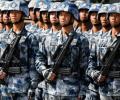
Chinese military has also deployed a sizeable number of its troops in Galwan Valley, the site of the violent clashes on June 15 that left 20 Indian soldiers dead.

China reiterated that no meaningful dialogue can be held with India until it "unconditionally" withdraws troops from the disputed Doklam area and said Foreign Minister Wang Yi has authoritatively made Beijing's position clear on the issue.

Outgoing Indian envoy to China Vikram Misri on Monday had a virtual farewell call on Chinese Foreign Minister Wang Yi during which he said that "certain challenges" had overpowered the vast opportunities in the bilateral ties last year and hoped that with continued communication the two sides would be able to resolve the current difficulties.

He said China has accrued significant capacities for force mobilisation, application, and sustenance of military operations and maintained the long-pending boundary issue can not be divorced from bilateral relations between the two Asian giants.
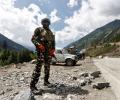
At a virtual media briefing, Ministry of External Affairs (MEA) Spokesperson Anurag Srivastava said disengagement of troops is a complex process which would require mutually agreed 'reciprocal actions'.
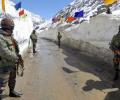
The clear assertion by New Delhi came ahead of a fresh round of Lt General-level talks between the Indian army and the Chinese PLA which government sources said is set to take place within the next two days.
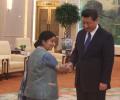
Chinese President Xi Jinping on Monday received External Affairs Minister Sushma Swaraj

India and China are in talks to monitor the melting of glaciers in the Himalayas, a border region crucial to both countries' water supplies, Minister for Environment Jairam Ramesh has said. "We are talking to the Chinese about monitoring the Himalayan glaciers," Ramesh said. However, he cautioned that India would not allow Chinese scientists "to climb all over India's glaciers", but sought a collaborative research programme.
China also hinted that India was objecting to its efforts to build the road in Donglang area of the Sikkim sector on behalf of Bhutan.

China said that it had put off the visit of Indian pilgrims who enter Tibet via the Nathu La pass "for safety reasons" in view of the border issue.
The MEA spokesperson did not reply to questions like whether the US had approached India with the offer, whether New Delhi has communicated its response over it to Washington, DC or whether the Trump administration has been briefed about the current standoff between Chinese and Indian soldiers in eastern Ladakh.
'Prime Minister Narendra Modi appears to have gone beyond the cautious approach usually advocated by the tightly-knit 'China group' in the ministry of external affairs in dealing with Beijing.'

The Chinese military has already completed moving back its troops from the face-off sites in Galwan Valley, Gogra and Hot Springs in line with the first phase of the disengagement process from the friction points on the LAC in eastern Ladakh, sources said. The main focus now shifts to Pangong Tso. India has been insisting that China must withdraw its forces from areas between Finger Four and Eight.
India and China are understood to have discussed the latest row over Sikkim on Thursday, during talks between their Foreign Ministers, dominated by the festering boundary issue, with the two sides agreeing to use existing mechanisms whenever necessary to maintain peace and tranquility along the border.External Affairs Minister Pranab Mukherjee, who is on a four-day official visit to China, met his counterpart Yang Jiechi and discussed issues of mutual concern.

Raking up the border issue, Congress leader Rahul Gandhi on Friday said every individual in Ladakh knows that China has "taken away our land" and claimed that Prime Minister Narendra Modi's assertion that not an inch of land was taken away was "absolutely false".
The comments by External Affairs Ministry Spokesperson Anurag Srivastava came at a media briefing when asked about the fresh comments by the Chinese foreign ministry blaming India again for the border situation in eastern Ladakh.

Assistant Secretary for East Asian and Pacific Affairs David Stilwell made the remark on Thursday, adding that the Trump administration is closely watching the Indo-China situation.

'They will try more rounds of military level talks and move it to the diplomatic and political domain to see if there is a possibility of a solution -- and like the CDS said if that does not happen, we are prepared.'

Dai Bingguo, who served as the China's boundary negotiator with India from 2003 to 2013, told Chinese media, "If the Indian side takes care of China's concerns in the eastern sector of their border, the Chinese side will respond accordingly and address India's concerns elsewhere."
Instead of "the dragon and the elephant compete with each other", "the dragon and the elephant dance together, Chinese Foreign Minister Wang Yi said.
India's top military and strategic brass on Tuesday reviewed the overall situation in eastern Ladakh amid indications that the latest round of talks between senior military commanders of Indian and Chinese armies on the next phase of disengagement of troops may not have produced encouraging results, people familiar with the developments said.
Singh said a meeting between senior Indian and Chinese military leaders has been scheduled for June 6 even as he asserted that India is not going to back off from its position. Asked about the current situation in sensitive areas in eastern Ladakh, he said Chinese have come up to what they claim is their territory while Indians believed it is theirs.
The Lalu Prasad-led Rashtriya Janata Dal MPs, including his daughter Misa Bharti and Manoj Jha, also staged a protest at Mahatma Gandhi's statue inside the Parliament complex and contended that despite being the chief opposition party in Bihar and the single largest party in the Assembly, it was not invited.

Out of 18, four personnel were critically injured but they are responding to treatment and are stable now, people familiar with the matter said.

It took India and the Indian Army to show to the world that enough is enough and to challenge the neighbourhood bully, he said.
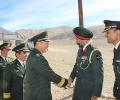
Amidst reports of Chinese incursions, the Peoples Liberation Army and the Indian Army on Sunday decided to uphold treaties and agreements signed between the governments of the two sides to maintain peace and tranquility along the Line of Actual Control.

Northern Army commander Lieutenant General Upendra Dwivedi on Friday said the situation along the Line of Actual Control in eastern Ladakh was stable but in a state of "heightened alert" and asserted that there would be no security lapse on fronts of "operational preparedness and readiness" along the India-China border.
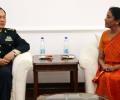
Wu said both the countries are also in consultations to work on a new Memorandum of Understanding (MoU) between the defence ministries.

'We can expect heightened belligerence from China.'

Both sides to enhance cooperation in combating international terrorism.

A steady line of supplies is being maintained for the soldiers at the site, official sources said.

The stand by China spelt out by its foreign ministry insisting that it takes the 1959 line on perception of the LAC amid a nearly five-month-long border standoff in eastern Ladakh triggered a strong reaction from India.
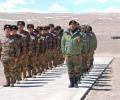
There was no comment from the Indian side on the statement made by the Chinese defence ministry spokesperson Colonel Wu Qian, and carried by China's official media.
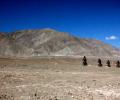
While the de-escalation process was underway, a violent face-off took place on Monday night between Indian and Chinese troops leading to the death of 20 Indian soldiers.

The Chinese military on Friday confirmed that the troops of China and India have begun the process of disengagement from the Patrolling Point 15 in the Gogra-Hotsprings area of eastern Ladakh in a 'coordinated and planned way'.

Home Minister Rajnath Singh on Friday said that India wants peace with China but that cannot come at the cost of honour.

He termed the situation with China as 'very dangerous' and said India under Modi does not have any clear cut strategy on China, which is testing the country and will not sit silent.
Both India and China have demonstrated levels of maturity in diffusing tensions and ensuring that the border remains by and large incident free, says Seema Mustafa
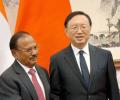
NSA Doval is set to travel to Beijing this week to attend the BRICS NSAs meeting scheduled to be held from July 27-28

Chinese President Xi Jinping's visit to India is a time for the two countries to get away from the haze of rhetoric and stale euphoria, says Sana Hashmi.
